About
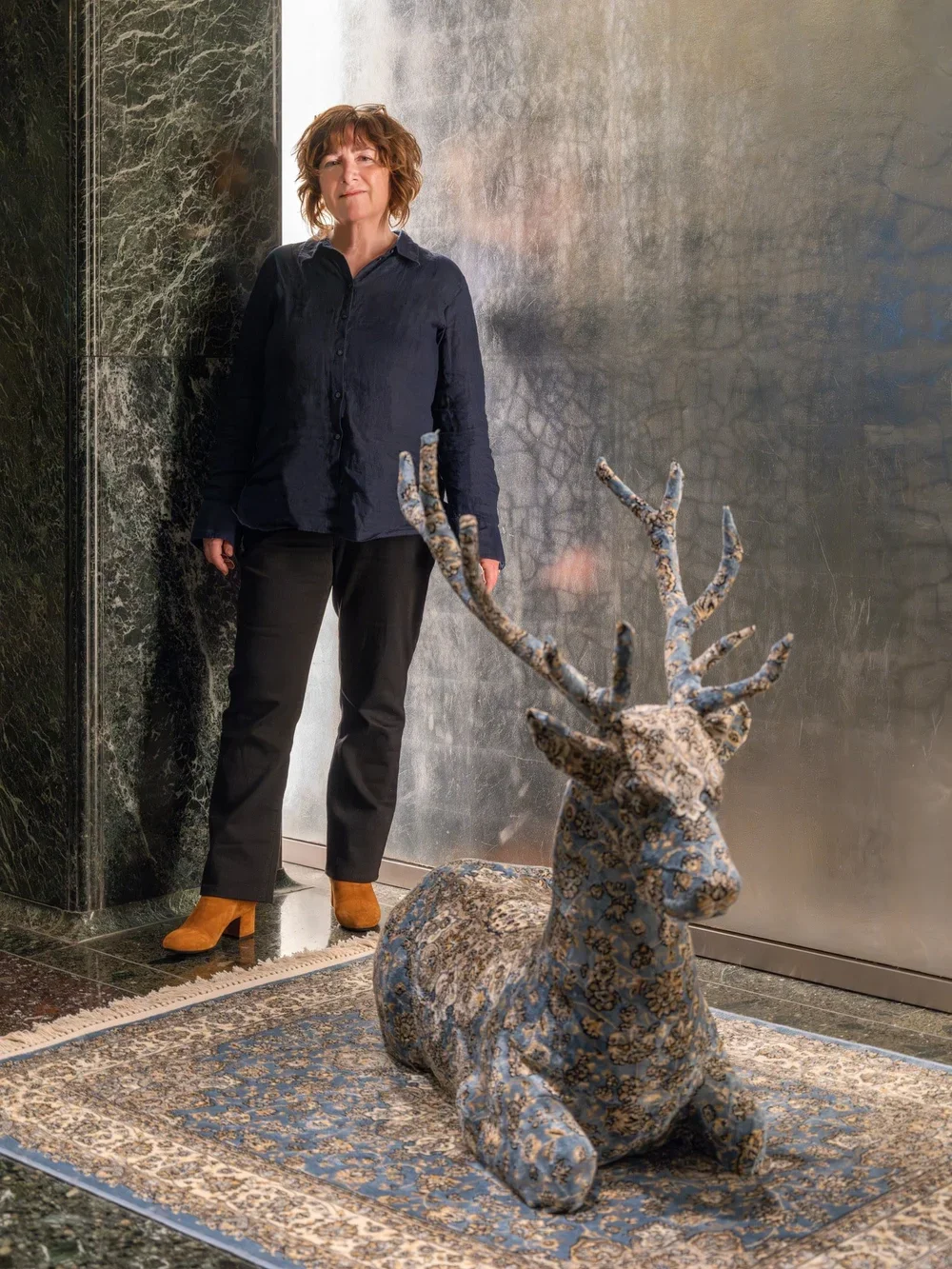
Debbie Lawson at the Rockefeller Center, New York.
Photograph by Daniel Greer, courtesy of Art Production Fund
Debbie Lawson (b. 1966) is a British multimedia artist whose practice explores the shifting boundaries between the domestic and the wild. Best known for her life-sized animals cloaked in Persian carpets, Lawson transforms decorative textiles into uncanny sculptural forms in which foxes, wolves, bears, birds and big cats appear to emerge from intricate woven patterns. Balancing illusion with material presence, her work examines camouflage, ornament and metamorphosis, drawing attention to the ways nature has long been embedded within decorative traditions – from classical architectural ornament and heraldic motifs to Victorian design and domestic interiors.
Born in Dundee, Scotland – a city with a rich history of textile production – Lawson has developed a practice deeply informed by the intertwined histories of craft, decoration and women's labour. She considers the home as both a site of comfort and psychological tension, where beauty can conceal unease and the familiar can become strangely animate. ‘I've always been drawn to stories in which inanimate things come to life – tales that hint that our surroundings have desires and mischief of their own,’ she explains. Her sculptures invite viewers to reconsider hierarchies that have long separated art from craft, decoration from fine art and domestic interiors from the natural world.
Lawson graduated with an MA in Sculpture from the Royal College of Art, a First-Class BA in Fine Art from Central Saint Martins, and a BA (Hons) in English Literature from the University of East Anglia. Her work has been the subject of solo exhibitions including In A Cowslip's Bell I Lie, Sargent's Daughters, New York (2026); Art in Focus: Debbie Lawson, Rockefeller Center, New York, commissioned by the Art Production Fund (2023–24); Magic Carpet, Fergusson Gallery, Perth (2013); Living Rooms, Nordisk Kunst Plattform, Norway, supported by the British Council (2009); and Chairway to Heaven, Economist Plaza, London, commissioned by the Contemporary Art Society (2008).
Her work has been featured in numerous group exhibitions, including Material Power, Hardwick Hall, National Trust, Derbyshire (2025); Royal Academy Summer Exhibition (2024), London; Carpets of Eden, Gardens of Fantasy, Leila Heller Gallery, Dubai (2024); Reimag(in)ing the Victorians, Djanogly Gallery, University of Nottingham (2023); and Seeing With Your Feet: The Carpet in Contemporary Art, Museum Villa Rot, Germany (2022), among others.
Lawson's work is held in the collections of the UK Parliament, Nottingham Castle Museum, Perth Art Gallery, the University of the Arts London, the University of Dundee, the Saatchi Gallery, and numerous private collections internationally, including MATE, Museo Mario Testino, Lima. She lives and works in Kent, England.
Debbie Lawson is represented by Sargent’s Daughters.
Artist statement
I live and work in rural Kent, surrounded by fields, furniture and fabric. The home has always felt alive to me: tables shift, chairs stretch, carpets ripple, objects hum… I make sculptural installations that occupy a space between the real and the imagined. Animals emerge from patterned carpets and familiar household items move or disguise themselves.
My work grows out of that space where the ordinary becomes uncanny – where a living room can turn into a forest or a vast rolling tundra landscape. I’ve always been drawn to stories in which inanimate things come to life – the magic pot of porridge, Mary Poppins’s tidying bedroom – tales that hint that our surroundings have desires and mischief of their own.
Narratives in gothic novels and folk tales, where beauty often hides something wilder underneath, taught me that domestic order and wilderness are closer than they seem.
I often use traditional patterned carpets in my work. They are familiar objects in the home, but also suffocating, decorative skins. When animals appear inside them – a bear, a stag, a fox – they seem to be camouflaged, though they counteract the very fabric of their confinement.
When people encounter my work I hope they feel a flicker of recognition: that strange mix of comfort and unease when something you thought you knew starts to breathe.